
// ARTICLE
Reading the Pirots 5 numbers
A percentage only becomes useful when you put your own stake behind it. Every figure below is counted at 0.20 EUR, 1.00 EUR and, where it matters, at the 100 EUR top of the ladder.
Return to player is a long-run figure, and Pirots 5 has more than one of them. The studio publishes a range that tops out at 96.0%, casinos choose a setting from inside it, and the difference between the top and the bottom is bigger than anything your bet sizing will ever do. Here is how to read the number, and what each of the other figures is worth in money.
Why the Pirots 5 RTP differs between casinos#
The studio ships a range; the casino picks the setting. That is the whole mechanism, and once you know it, the conflicting figures across review sites stop being confusing. The published range runs up to 96.0% depending on the casino and the market, and the configurations operators choose between are 96%, 94%, 92%, 90% and 87%. One European state operator, for instance, serves the game at 94%, two points below the top of the range, which is a concrete reminder that the spread is real rather than theoretical.
What that means for a hundred spins at 1.00 EUR, which is the default stake the demo opens on:
| Configuration | Theoretical return on 100 spins at 1.00 EUR | What it means for you |
|---|---|---|
| 96% | 96 EUR of 100 EUR staked | The top of the published range and the setting the demo runs |
| 94% | 94 EUR | A common regulated-market setting; 2 EUR more house edge per 100 spins than the top |
| 92% | 92 EUR | Mid-range; the same reels, a noticeably thinner long run |
| 90% | 90 EUR | 6 EUR per 100 spins below the top configuration |
| 87% | 87 EUR | The bottom of the range: 9 EUR per 100 spins below the top |
None of those numbers predicts your evening. A hundred spins is far too short a run for a theoretical percentage to assert itself, especially at 7 of 10 volatility. What the table does show is which decision matters. The distance between the top configuration and the bottom one is nine percentage points, or 9 EUR of theoretical return on every 100 EUR you stake, and choosing the right side of it takes five seconds: open the game’s rules panel in the casino you are in and read the figure it states. Nothing else on this page is worth 9 EUR per 100 spins to you.
Volatility 7 of 10 in practice#
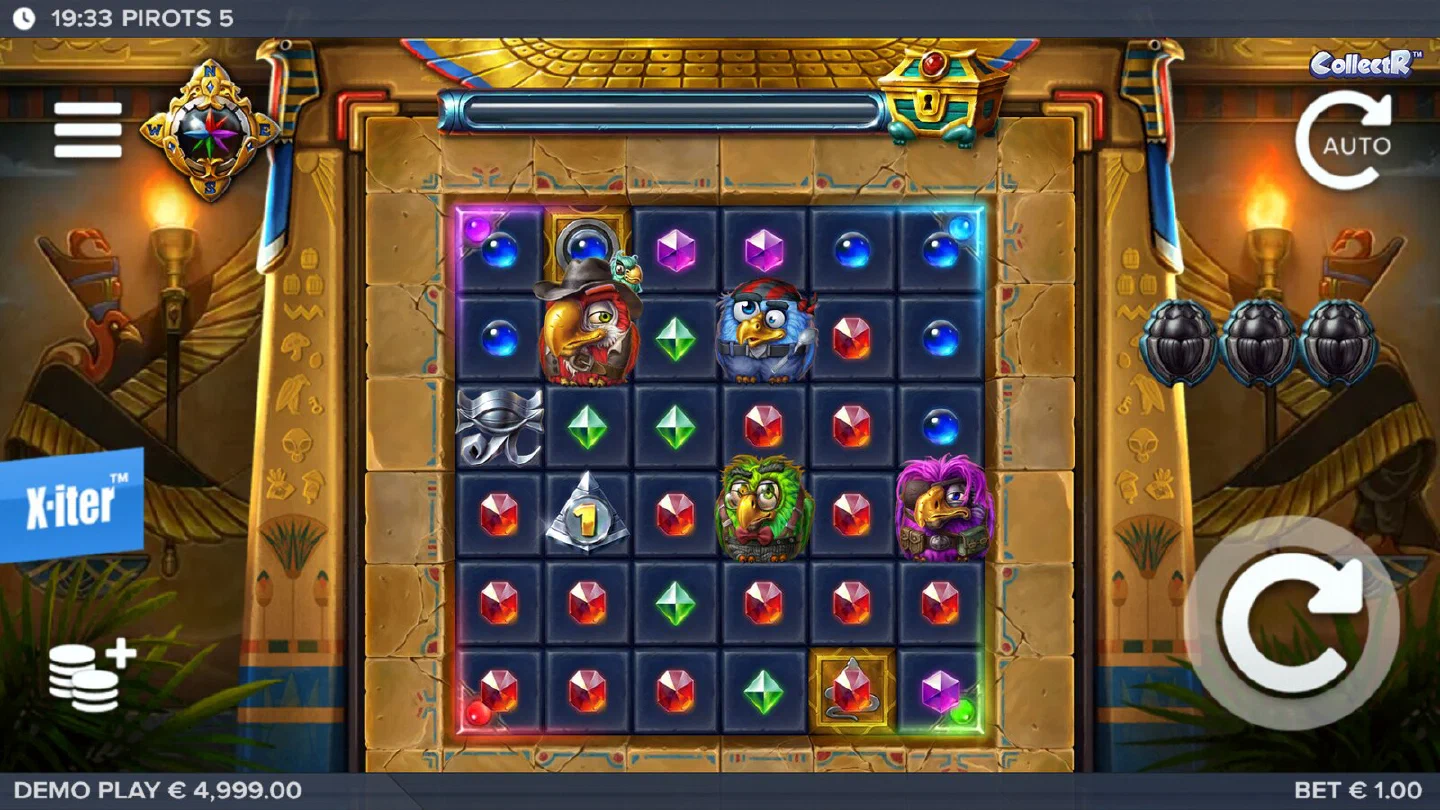
Seven of ten shows up in the shape of the session rather than in any single spin. The birds collect small clusters, the meter above the grid creeps upward, and the balance moves in small steps that do not quite keep pace with the stake. Then three queued feature releases land at once on a board that has room to grow, the gems jump payout levels, and one round returns more than the previous fifty.
That shape has a practical consequence: your stake has to be small enough that you are still playing when the good round arrives. At 0.20 EUR a 100-spin session costs 20 EUR of turnover; at 1.00 EUR it is 100 EUR. Both are perfectly reasonable, but the same 100 EUR buys 100 rounds at the higher level and 500 at the lower one. Variance does not reward being early, it rewards being present, and the strategy page turns that into a stake plan with numbers attached.
One thing the rating is not: it is a description of distribution, not a difficulty setting. A 7 of 10 game does not owe you a big round after a flat stretch, and the flat stretch is not evidence that one is coming. Every spin is drawn independently.
How often Pirots 5 pays#
Two figures exist, and both are true of what they describe: 25.1% on the product sheet and 26.11% in the demo configuration that runs 96.0%. Either way, roughly one spin in four gives you something back.
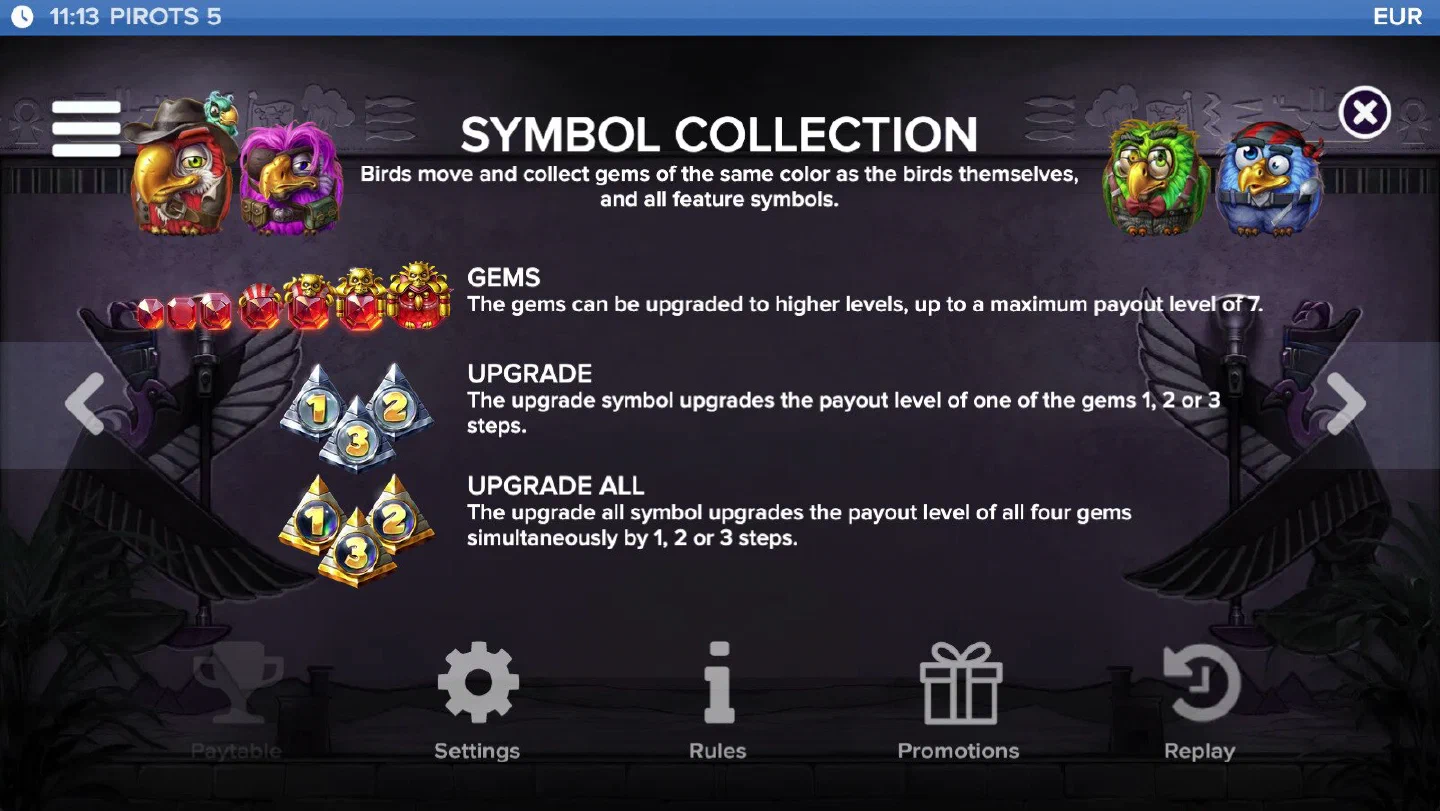
The interesting part is what “something” is worth. Gems enter the board at payout level 1, so a hit taken before any upgrade has landed pays at the bottom of its ladder: red at 10 coins, blue and purple at 5, which at 100 coins to a bet is a tenth or a twentieth of your stake. Those collections keep the session moving and they feed the meter, but they are not where the game’s money lives. That sits at the top of the ladder, red at 2,500 coins and the premium group at 3,000, which is 25x and 30x your bet from a single collection, and the only path there is the upgrade symbols.
So the hit rate is best read as tempo rather than as profit. About a quarter of spins pay, nearly all of them small, and the upgrades decide whether the session turns. That is also why the free demo is genuinely useful here: fifty spins in the demo show you the rhythm far faster than any percentage can.
Where the 96.0% actually comes from#
Return to player is an average over an enormous number of rounds, and it is assembled from parts you can see while you play. In Pirots 5 there are three.
The base collection. Four birds, collecting adjacent gems of their colour without fixed paylines, on a board that starts at 6x6 and expands to 8x8. This is the frequent, small component, about a quarter of spins, and it pays at whatever payout level the gems have reached.
The feature releases. The meter above the grid queues a release every time it fills, up to three pending at once. Upgrades, transforms, wilds and coins arrive from there, and their job is to raise the value of the next collections rather than to pay directly. This is the part of the return that feels like progress rather than income.
The bonus rounds. Three bonus symbols open the bonus game with bonus drops, carrying your grid size, meter progress and gem level in with you, plus up to ten bonus features; when one of the three collected symbols is a super bonus symbol, the super bonus game takes its place. This is where the long tail of the distribution lives, and it is why the volatility is 7 of 10 rather than something gentler.
The game ships with its jackpot module disabled, so none of the return is diverted into a progressive pool. Every unit of the published percentage is paid back through those three mechanisms. What you see on the screen is the whole game, with nothing held in reserve elsewhere.
Bets, coins and what the cap means in money#
10,000x is the ceiling of one round, not a promise about your session. The game also carries an exposure cap of 1,000,000 EUR per round, and the two meet exactly at the top of the bet ladder: 10,000x of 100 EUR is a million.
The bet ladder itself runs from 0.20 to 100 EUR across 12 levels, and every price in the game is a multiple of whichever level you pick:
| Your bet | Round cap at 10,000x | Bonus Hunt (3x) | Bonus (100x) | Super Bonus (250x) | Top premium gem (30x) |
|---|---|---|---|---|---|
| 0.20 EUR | 2,000 EUR | 0.60 EUR | 20 EUR | 50 EUR | 6 EUR |
| 1.00 EUR | 10,000 EUR | 3 EUR | 100 EUR | 250 EUR | 30 EUR |
| 10 EUR | 100,000 EUR | 30 EUR | 1,000 EUR | 2,500 EUR | 300 EUR |
| 100 EUR | 1,000,000 EUR | 300 EUR | 10,000 EUR | 25,000 EUR | 3,000 EUR |
Two things stand out. The first is how fast the purchase prices climb: the same Super Bonus press costs 50 EUR at the bottom of the ladder and 25,000 EUR at the top, a factor of 500. The span the game states for X-iter runs wider still, from 0.60 EUR: Bonus Hunt at 3x the 0.20 EUR minimum: to that same 25,000 EUR ceiling. The second is that the whole game stays open at the minimum. At 0.20 EUR the cap is still worth 2,000 EUR, the upgrade path to payout level 7 is unchanged, and the nine tokens towards Boss Castle count exactly the same.
As for reaching the cap: the path runs through upgraded gems, a grid grown from 6x6 to 8x8 and the ten features that travel into the bonus games. Every unit of payback lives in the base game and the bonus rounds, which keeps the ceiling within reach of a single ordinary spin rather than a separate counter.
The paytable, level by level#
Payback is an abstraction; the paytable is where it becomes concrete. Four gem colours pay, and each climbs seven payout levels. In coins, with 100 coins to a bet:
| Gem | L1 | L2 | L3 | L4 | L5 | L6 | L7 |
|---|---|---|---|---|---|---|---|
| Red | 10 | 25 | 40 | 75 | 200 | 625 | 2,500 |
| Green | 10 | 20 | 30 | 60 | 160 | 500 | 1,500 |
| Blue | 5 | 15 | 25 | 45 | 120 | 375 | 1,000 |
| Purple | 5 | 10 | 15 | 30 | 80 | 250 | 750 |
| Premium | 15 | 30 | 50 | 100 | 300 | 1,000 | 3,000 |
Three readings of that table are worth having. The first: gems enter the board at level 1, so every collection taken before an upgrade lands is priced at the bottom row, a twentieth to a tenth of your bet. That is the floor the hit rate is measured against, and no amount of volume raises it: only the upgrade symbols do.
The second: the climb is not linear, it accelerates. Red goes from 10 coins to 25 between levels 1 and 2, a step of 2.5 times, and from 625 to 2,500 between levels 6 and 7, a step of exactly four. The four upgrades from level 1 to level 5 add 190 coins; the two above them add 2,300. That is why an upgrade-all landing on an already-lifted board is the game’s decisive moment rather than a pleasant bonus.
The third: the top of the ladder is genuinely large for a single collection. Red at level 7 is 2,500 coins, or 25x your bet: 5 EUR at the minimum stake and 25 EUR at 1.00 EUR. The premium group reaches 3,000 coins, which is 30x. Stack those against a board grown to 8x8 and the path to the round cap stops being theoretical.
X-iter and the payback#
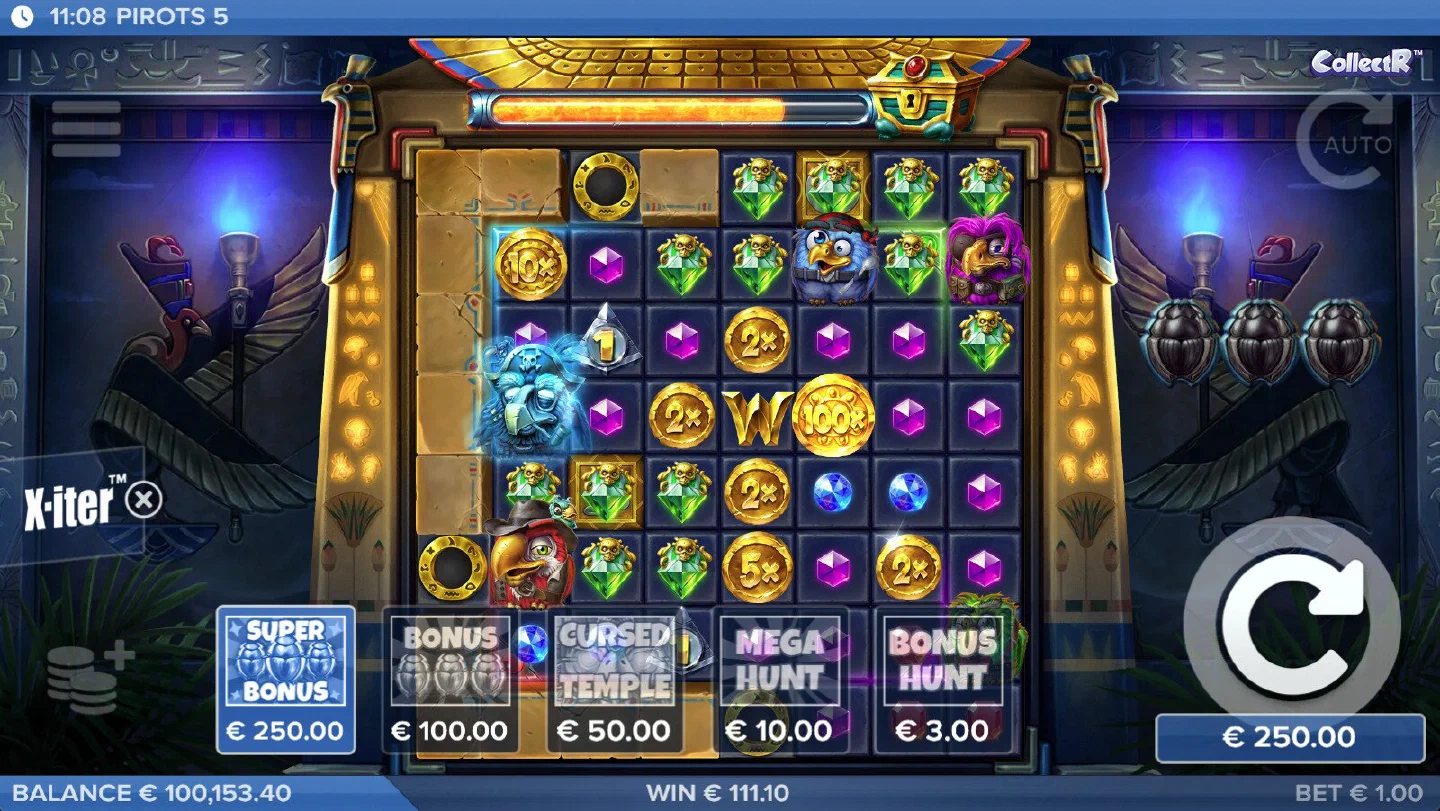
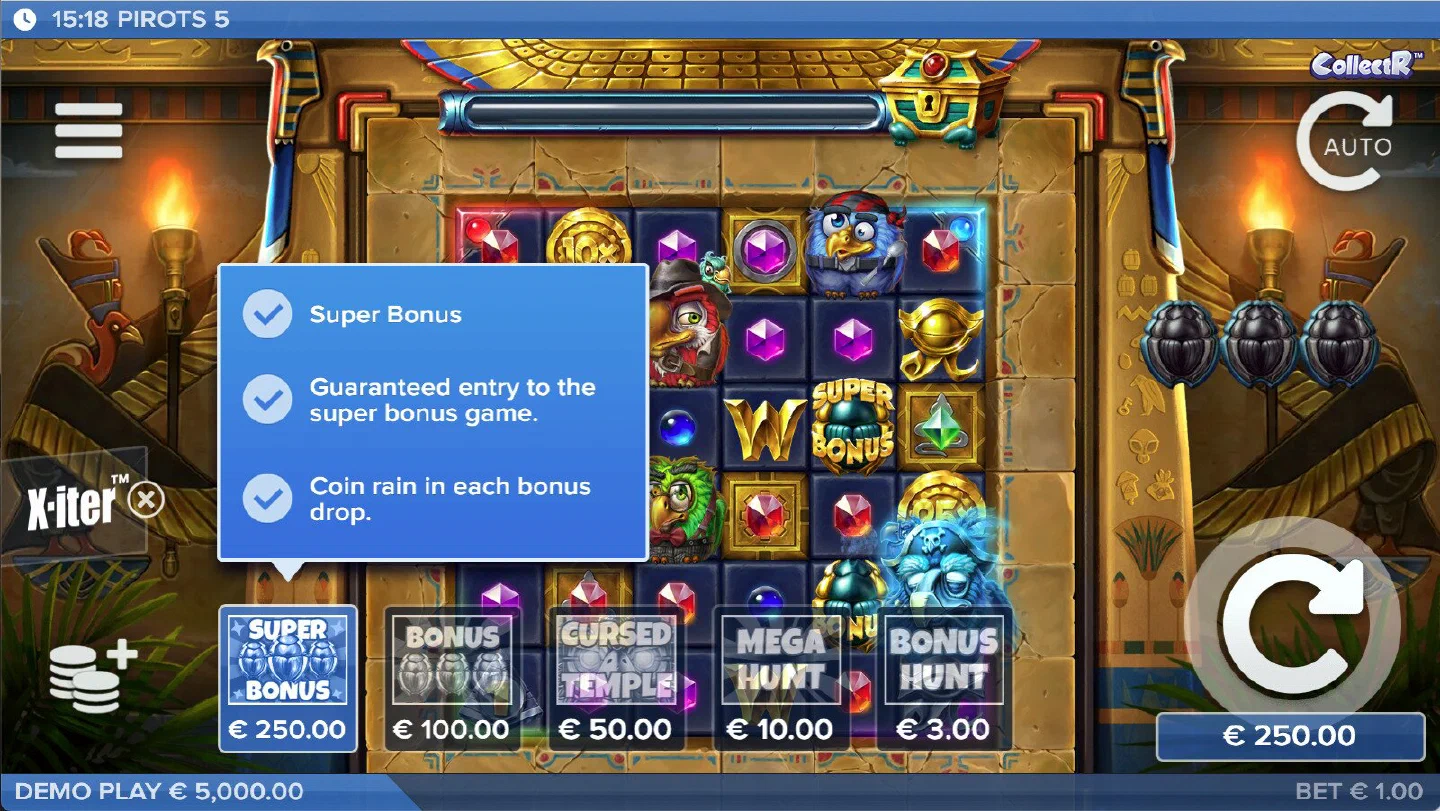
The five X-iter modes are bought from the base game: Bonus Hunt at 3x the bet, Mega Hunt at 10x, the world coin game at 50x, Bonus at 100x and Super Bonus at 250x. The two hunt modes raise the chance of the bonus: more than 4x in the Cursed Temple and 5x in the other worlds for Bonus Hunt, more than 10x or 20x for Mega Hunt. The three higher prices guarantee the round they name.
The sentence that matters for this page: the theoretical payout for all X-iter modes equals the game’s RTP. Buying does not thin the return and it does not improve it. What it changes is the distribution. Pressing Bonus at 100x moves your stake into one round instead of a hundred, so your session becomes shorter, sharper and far more dependent on that single outcome. If you like that trade, it is a clean one, priced openly. If you do not, the base game reaches the same places for the same theoretical return, just more slowly.
One practical note: a price is a price, not a frequency. Super Bonus at 250x costs what 250 base spins cost. It says nothing about how often the bonus arrives on its own. The features page breaks each mode down, and the slot’s main page puts the maths back next to everything else the game does.