Pirots 5 is the sixth game in the ELK Studios bird series, and it hands you a decision before it shows you a symbol. The entry map offers Cursed Temple, The Kraken and City of Gold, all under one game id, 10266, released on 23 July 2026. We played all three, then went back for the castle.
How Pirots 5 actually plays#
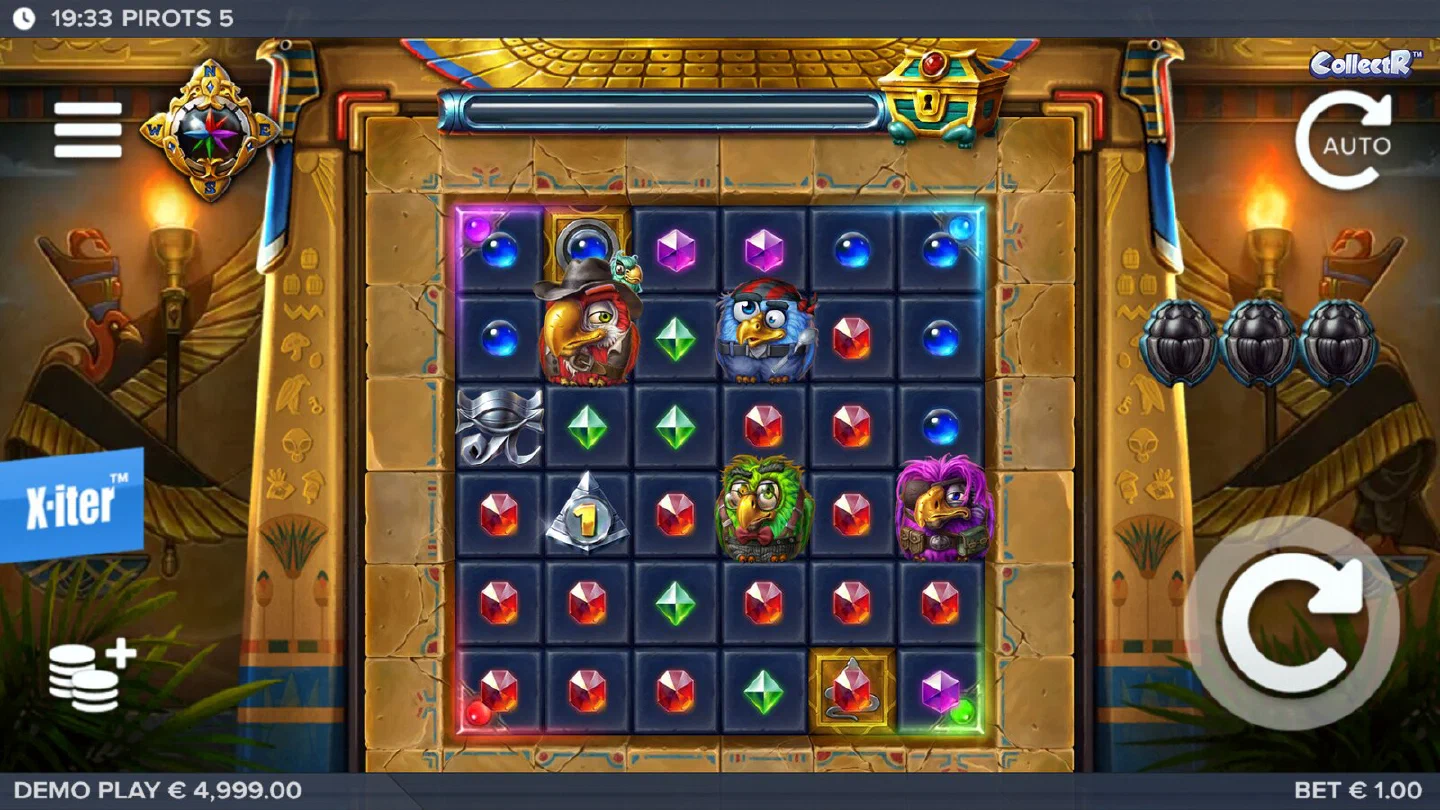
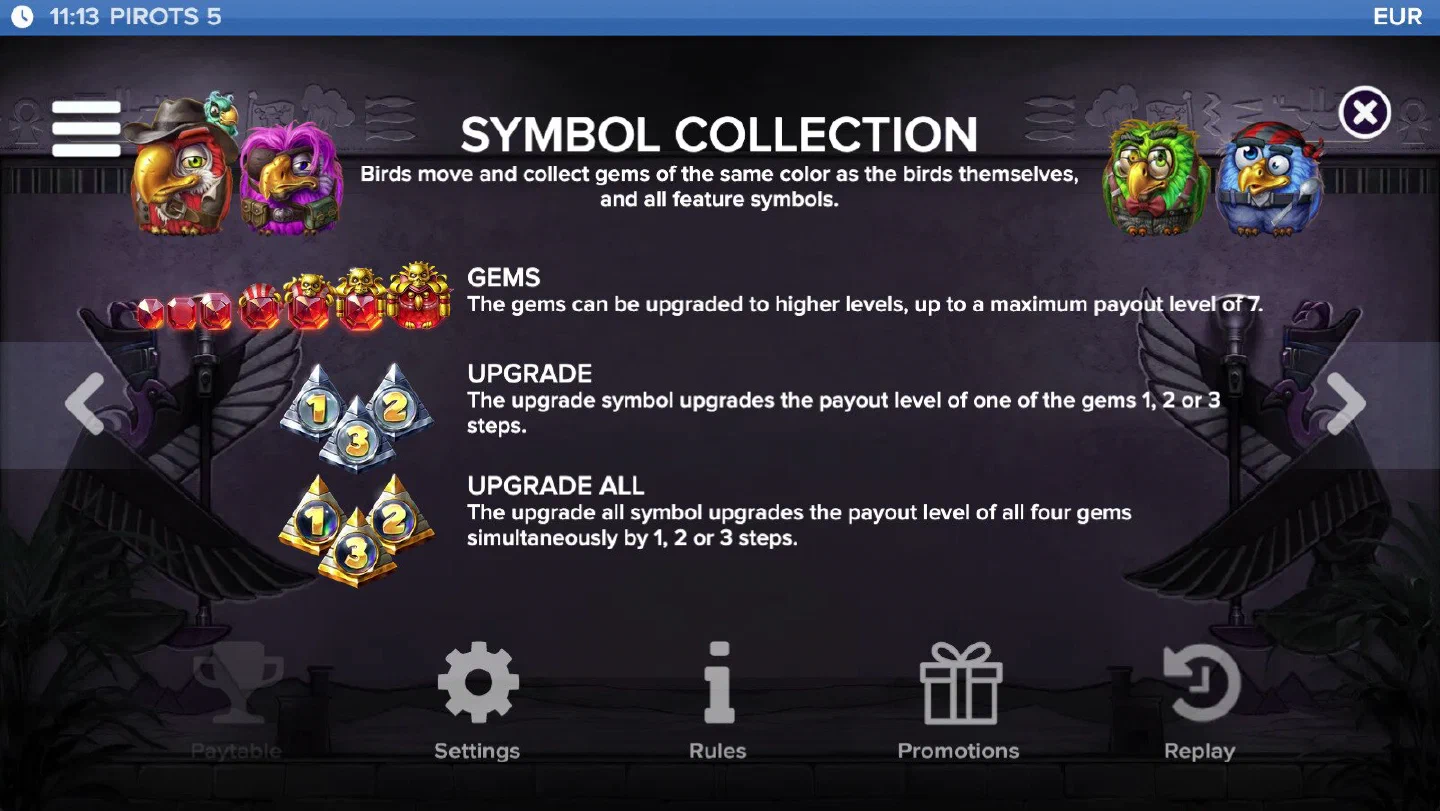
Something happens on about a quarter of spins: 25.1% by the product sheet, 26.11% in the demo configuration, and that number sets the whole rhythm. Gems land at payout level 1, where red pays 10 coins against a bet worth 100, so until the upgrades arrive a hit is a tick rather than a result. A bird walks into a short run of its colour, the meter moves, the grid refills. The payout comes from what was collected, not from a shape landing on named reels, so you spend the spin watching a path rather than waiting for a line.
That makes the flat stretches easier to sit through than the 7 of 10 volatility rating suggests. The meter above the grid is doing something on nearly every spin even when the balance is not, and because a filled meter queues a feature-symbol release, the game is visibly saving up. Up to three releases can be pending at once, and when three land together on a board where the birds already have room to walk, the result is the step change the game is built around.
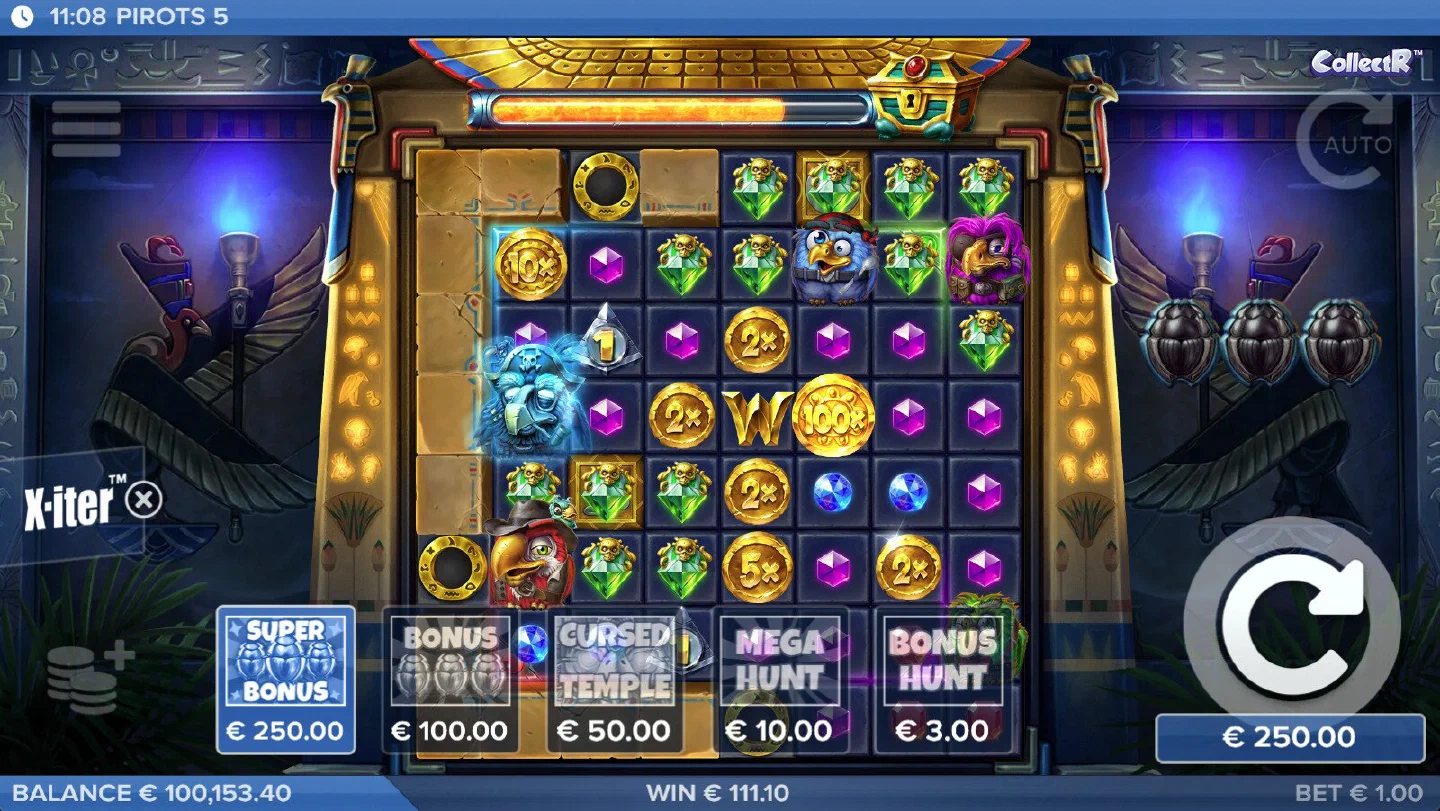
The other reason the board rarely feels static is that the grid itself moves. It starts at 6x6 and grows to 8x8, which is 36 positions becoming 64. The secret door rotates the entire thing, carrying symbols and birds with it. Portals open among the walls, four at most at a time, and let a bird teleport, with connected walls acting as tunnels that can turn up feature symbols on the way. Cross-over floor tiles let a bird walk back across positions it has already cleared, which is exactly the small permission a collection game needs to keep a run alive.
There is a counterweight, and it is a good one. The rim of the grid carries traps: arrow shooters in the Cursed Temple, harpoon shooters in The Kraken. They fire when the birds can no longer collect, and a hit bird is removed with its gems turned over to another bird’s colour. A run does not fade out, it gets cut off, and the difference in tension is real. The compensation is that the colour left behind is now concentrated, which is the setup for the next long walk.
Three worlds, three tempos#
The worlds share the maths and split the personality. Ten feature symbols each, one corner fight each, one coin game each, three tokens each.
Cursed Temple#
The default and the most straightforward. A bird walks into the catacombs to fight a mummy, and four won fights put a coin on every coffin position on the grid. Its coin game triggers when the secret door clears the board entirely, which makes the temple the world where the rotation feature matters most. The arrow shooters on the rim keep the pressure honest. Captain Blackfeather shows up here as he does everywhere, turning one to four birds into ghosts and converting their gems into Blackfeather gems that can sit as high as payout level 7; he persists between bonus drops and is guaranteed to win a catacomb fight, which is why a Blackfeather landing in the temple is worth more than the same symbol anywhere else.
The Kraken#
The sea world swaps arrows for harpoons and the temple’s feature symbol for the golden compass cannon. Its corner feature is the captain’s quarters and a land-crab fight. What sets its tempo apart is the coin game: three drops that reset whenever a landing symbol appears, so instead of counting down towards an end it keeps buying itself more time. It is the most open-ended of the three and the one where a round can stretch furthest past the point you expected it to finish.
City of Gold#
The richest-looking world and the one with the most board in play. The golden book is its feature symbol, the treasure chamber and a shaman fight sit in the corner, and its coin game runs across the full 8x8 grid with three drops, where the Mastermind expands to cover up to 5x5 of the board on its own. If you want the big-canvas version of Pirots 5, this is it.
Collect the three tokens in each world and Boss Castle opens permanently: three reels, one row, one payline and a bonus of its own, which is a deliberate joke after 64 positions of collection. A token also pays as it lands, at the value of a 5x coin, so the trip to the castle pays its own way. The features page has every symbol, trigger and fight in detail.
The bonus game and what X-iter buys#
Three bonus symbols collected by the birds open the bonus game, which plays as bonus drops. What makes it worth working towards is the inheritance: grid size, collection-meter progress and the payout level your gems have reached all travel in with you, so the bonus starts from the board you built rather than from scratch. Up to ten bonus features can come along: the bandit, the alien invasion, the yeti, fire minions, Charlie, cursed treasure, the golden compass cannon, the Kraken, the golden book and the Mastermind. The round runs until the hearts are gone or the maximum win lands. A super bonus symbol among the three opens the super bonus instead.
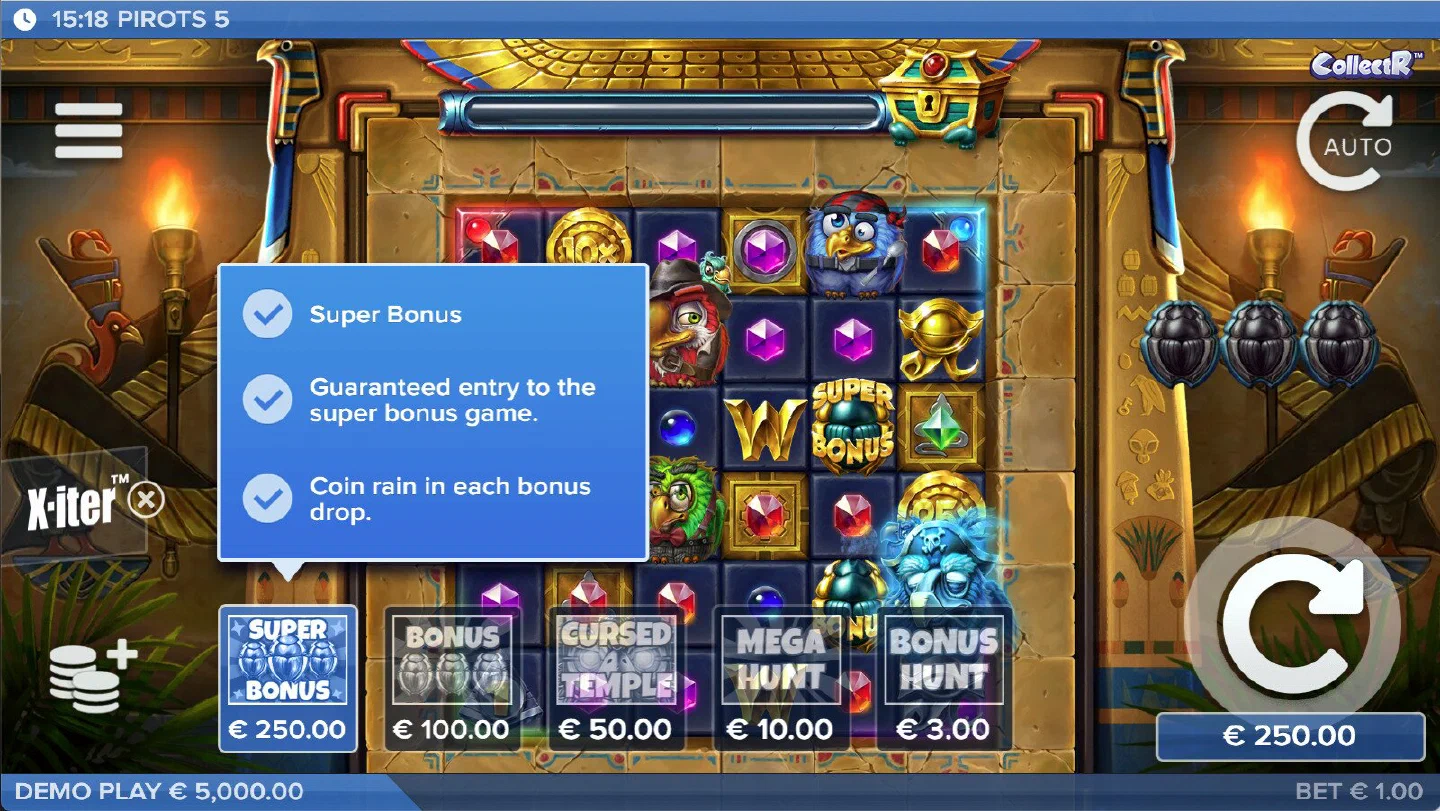
X-iter is the paid door to the same rooms. Five prices, bought from the base game:
| Mode | Price | At 0.20 EUR | At 1.00 EUR | What the price gives you |
|---|---|---|---|---|
| Bonus Hunt | 3x the bet | 0.60 EUR | 3 EUR | More than 4x the bonus chance in the Cursed Temple, 5x elsewhere |
| Mega Hunt | 10x the bet | 2 EUR | 10 EUR | More than 10x or 20x that chance |
| World coin game | 50x the bet | 10 EUR | 50 EUR | Entry to that world’s coin game |
| Bonus | 100x the bet | 20 EUR | 100 EUR | The bonus game |
| Super Bonus | 250x the bet | 50 EUR | 250 EUR | The super bonus game |
Across the twelve bet levels those prices span 0.60 to 25,000 EUR, which is a range to respect. The line that earns the game credit in this review: the theoretical payback of every X-iter mode equals the payback of the game. You are buying the bonus sooner, not buying a better edge, and the game says so rather than leaving you to guess. Boss Castle extends the idea with its own trio: Boss Battle with three features, Castle Mayhem with four, Ultimate Showdown with five.
Where does the money in a big round actually come from? Payout levels. Each gem colour climbs through seven of them, and the top of the ladder is a different game from the bottom: red pays 10 coins at level 1 and 2,500 at level 7, and the premium group tops out at 3,000 coins, which is 30x your bet at 100 coins to a bet. The path to the 10,000x round cap runs through upgraded gems, a grid grown to 8x8 and the features that carry into the bonus.
What a session actually costs#
A review that skips the money is half a review, so here is what the game asks of you. The bet ladder runs from 0.20 to 100 EUR across 12 levels, and every price in the game scales from whichever step you pick.
| Your bet | 100 rounds | Bonus Hunt (3x) | Bonus (100x) | Round cap (10,000x) |
|---|---|---|---|---|
| 0.20 EUR | 20 EUR | 0.60 EUR | 20 EUR | 2,000 EUR |
| 1.00 EUR | 100 EUR | 3 EUR | 100 EUR | 10,000 EUR |
| 10 EUR | 1,000 EUR | 30 EUR | 1,000 EUR | 100,000 EUR |
What that table says about the game is more interesting than the arithmetic. Nothing is withheld at the bottom of the ladder. A 0.20 EUR session opens all three worlds, climbs the same seven payout levels, counts the same nine tokens towards Boss Castle and still has a round cap worth 2,000 EUR behind it, with Bonus Hunt at 0.60 EUR a press. The cheap seat is the same seat.
The second thing it says is that the purchase prices are the numbers you will actually argue with yourself about. A Bonus at 100x costs a hundred ordinary spins. On a 1.00 EUR stake that is 100 EUR moved into one round, and with volatility at 7 of 10 the spread of outcomes from that single round is enormous. The game is straight with you about it, at least: the theoretical payback of an X-iter round is the game’s own, so the choice is about session shape, not value.
Who Pirots 5 is for#
The collector. If you like a board that visibly accumulates, this one gives you three layers of it at once: a meter that queues up to three feature releases, gems climbing seven payout levels, and nine tokens counted towards a fourth world that stays unlocked. The spine of a session runs past the individual spin.
The bonus hunter. Five stated prices and the game’s own payback in each mode is about as clean as a feature buy gets. Start at Bonus Hunt for 3x, see what the improved chance feels like, and keep Super Bonus at 250x for a decision you have actually planned. Strategy has the stake arithmetic.
The minimum-stake player. At 0.20 EUR the whole game is open: the 10,000x cap is worth 2,000 EUR, Bonus Hunt costs 0.60 EUR, Super Bonus 50 EUR, and a token counts for exactly what it counts for at 100 EUR a spin. The bet level changes the cash on the screen and nothing else about the game.
The one profile to be honest with: if you want an even rhythm, 7 of 10 will feel heavy, and the comparison with Aftermath is the page to read before you pick. Otherwise, spin the demo above, then take it to a casino. The payback configuration varies by lobby, so read where to play before you deposit. The slot’s main page carries the full profile in one screen.